
Well-Being Hub
Safe Sport International
Project
The Well-being Hub is an accessible space created specifically for athletes, victims, parents, and guardians. It helps them to understand their rights, recognise what’s okay and what’s not, and learn the next steps by creating a safe space.

Safe Sport International
Individual Project / 6 months / Internship Project
Secondary Research / Interview / Surveys / Market Research
Laddering Technique / HMW Statements


PROBLEM
Generic Content, Limited Impact
SSI’s existing “Mental Health & Sports Cards” were informative but generic, with limited alignment to SSI’s mission and strategic goals. This lack of connection reduced engagement and missed the opportunity to fully support athletes in creating safe sport environments and engage with the target users.
SOLUTION
Your Safe Space in Sport
Designed a Well-being Hub tailored for athletes, victims, parents, and guardians, offering reliable information and guidance on mental health, safeguarding, and recovery, ensuring no one feels alone.

Empathetic
Personal stories on the Your Voice Matters page create a sense of connection and reduce isolation.
“Is My Environment Safe?” quiz helps athletes reflect on their experience in a non-judgmental way.
Answers to common questions & tips provide relatable and practical advice.
Informative
Clear explanation of safeguarding: What is Safeguarding? What’s OK, What’s Not.
Key statistics & common mental health problems on the Mental Health page for awareness.
Global Helplines & Get Help Now button for immediate support.
Guidance on what to do next after spotting a problem.


Hopeful
“Recovery is possible” message on the Self-Care & Recovery page to encourage resilience.
Link to mental health quiz to help athletes take the first step toward understanding their well-being.
Campaign ideas for social media to promote ongoing engagement and positive action.
Final Structure of the Well-Being Hub

Final Deliverables
As it was a research project, content was prioritised rather than the visual design.


SSI’s Mini Website Content
Well-Being Hub Main Page Layout
Your Voice Matters Page Layout
PROCESS
1.0 Exploration
Analysing the Current Content of SSI
I started by looking at SSI’s existing mental health content to understand what they are providing, who it is for, and how it is delivered.
This brought up some questions:
What is SSI’s position in the market?
What can SSI offer considering its capabilities?
Who are our target users and what are their needs?
The Outcome
These questions led me into market research, to see what other organisations are providing and how SSI could create something tailored to its vision.
2.0 Research
MARKET RESEARCH
How Can I Add Product Value to SSI’s Mental Health Cards?
I did benchmarking against similar organisations, athlete-focused mental health initiatives, to understand their current position and how I can differentiate among them.
The Outcome
SSI provides informative content but lacks a product value that distinguishes it in the market. This revealed an opportunity to create an engaging well-being hub that aligns with SSI’s mission and encourages users to interact more with the Webpage.


SECONDARY RESEARCH
Unsafe Sports Environments Increase the Risk of Mental Health Problems
To gain a deeper understanding of the problem, I researched athletes' mental health problems, their effects, signs, and relevant statistics using literature and existing studies.
The Outcome
This research highlighted the strong link between unsafe sports environments and increased mental health risks, which raised further questions.
The Questions
Does the SSI provide information about unsafe sport environments?
Are athletes aware of unsafe environments and how to act?
Are there any barriers preventing the athletes from speaking up?
ITERATION
Iteration: No Information About Unsafe Sport Environments on SSI’s Website
I revisited SSI’s website to see whether I could find information about unsafe sport environments, as it is their ultimate mission.
Findings
Unsafe environments are not clearly defined.
No guidance for athletes to recognise signs and know the next steps.
No clarity on who the athletes can approach for help.
PRIMARY RESEARCH
User Research: Interviews & Surveys
I conducted interviews and survey with athletes to validate my assumptions.
Assumptions
No awareness of unsafe environments and mental health issues
Lack of comfort in sharing concerns and preferred reporting ways
No perceptions of existing services and support from teams
Primary Research Summary
10
Interviews
16
Answers on the Survey
3.0 Analysis
Analysing the Data through Excel and Affinity Diagrams
Processed survey data in Excel, organising responses to uncover key patterns.
Used affinity diagramming to synthesise interview findings, grouping insights by recurring themes and user needs.
Identified pain points and opportunity areas that directly informed the content redesign and strategic decisions.
Key Insights
1- Lack of Guidance on Where to Seek Help
Most of the athletes don’t know where to seek help for their mental health concerns, as they don’t receive the necessary education from their organisations.
2- Fear and Stigma Prevent Athletes from Speaking Up
Most athletes hesitate to speak up about what they’re going through because of feeling like the problem isn’t that serious and the fear of being judged.
3- Low Awareness of Unsafe Sport Environments
The majority of the athletes didn’t receive training in recognising the unsafe sport environments, which reduces their awareness and leads them to ignore the signs.
4- Uncertainty About Taking Action Leads to Inaction
Even though the majority of the athletes have a general idea about taking action towards addressing concerns about their safety, they are not entirely sure which causes procrastination and ignorance in the long term.
4.0 Ideation
Ideation & Feature Prioritisation
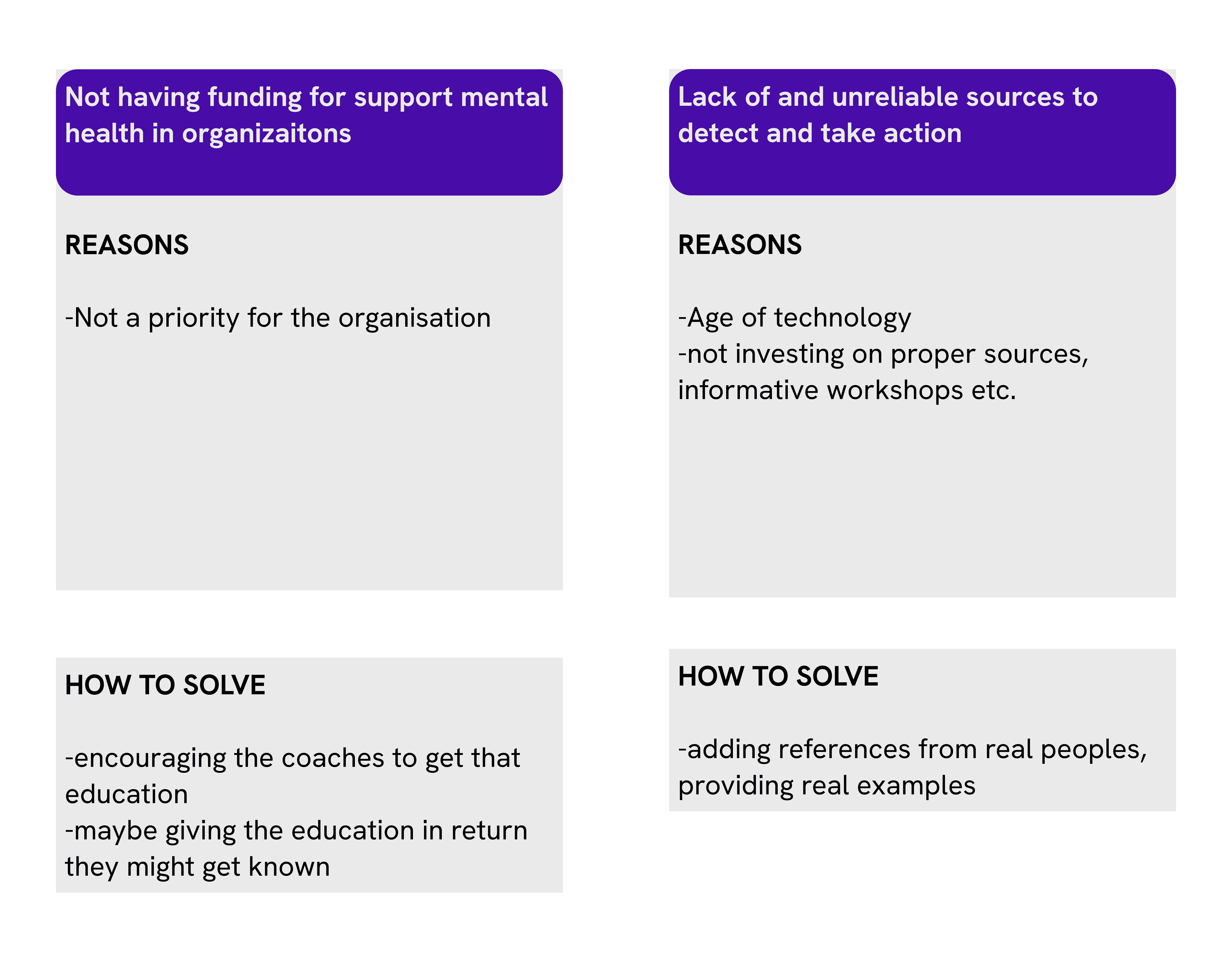
I continue by applying the laddering technique to the key pain points to find the core reasons and ideate the possible features accordingly.
Later on, I prioritised them by using 2x2 feasibility and SSI’s value matrix to ensure the feasibility of the concept while aligning with the company's mission.


5.0 Deliver
Finalising: Rewriting the Content Following GDS Standards and Accessibility Guidelines
Applied UX writing and accessibility principles to improve clarity and inclusivity.
Checked readability with Flesch-Kincaid and WebFX tools to ensure accessibility for diverse users.
Used digital storytelling to connect unsafe sport environments with mental health through data-driven narratives.
Refined and delivered the final content based on user insights and GDS standards.
REFLECTION
Limitations
Limited capabilities of SSI due to its lack of funding
What I’d Do Differently
I would’ve engaged more people from SSI, not just previous interns and the marketing department, and worked collaboratively for a more impactful outcome.
Mindset Change
I learned how to work in a professional setting with real constraints.
I learned how to prioritise the solution when coming up with new ideas, and think about the capabilities of the company to bring the solution to life.